Upasana Taku Turned Down a PayPal Career to Bet on Cash-Only India
Investors asked her personal questions instead of business ones. Sixteen years later, she took MobiKwik public as India's first profitable fintech company
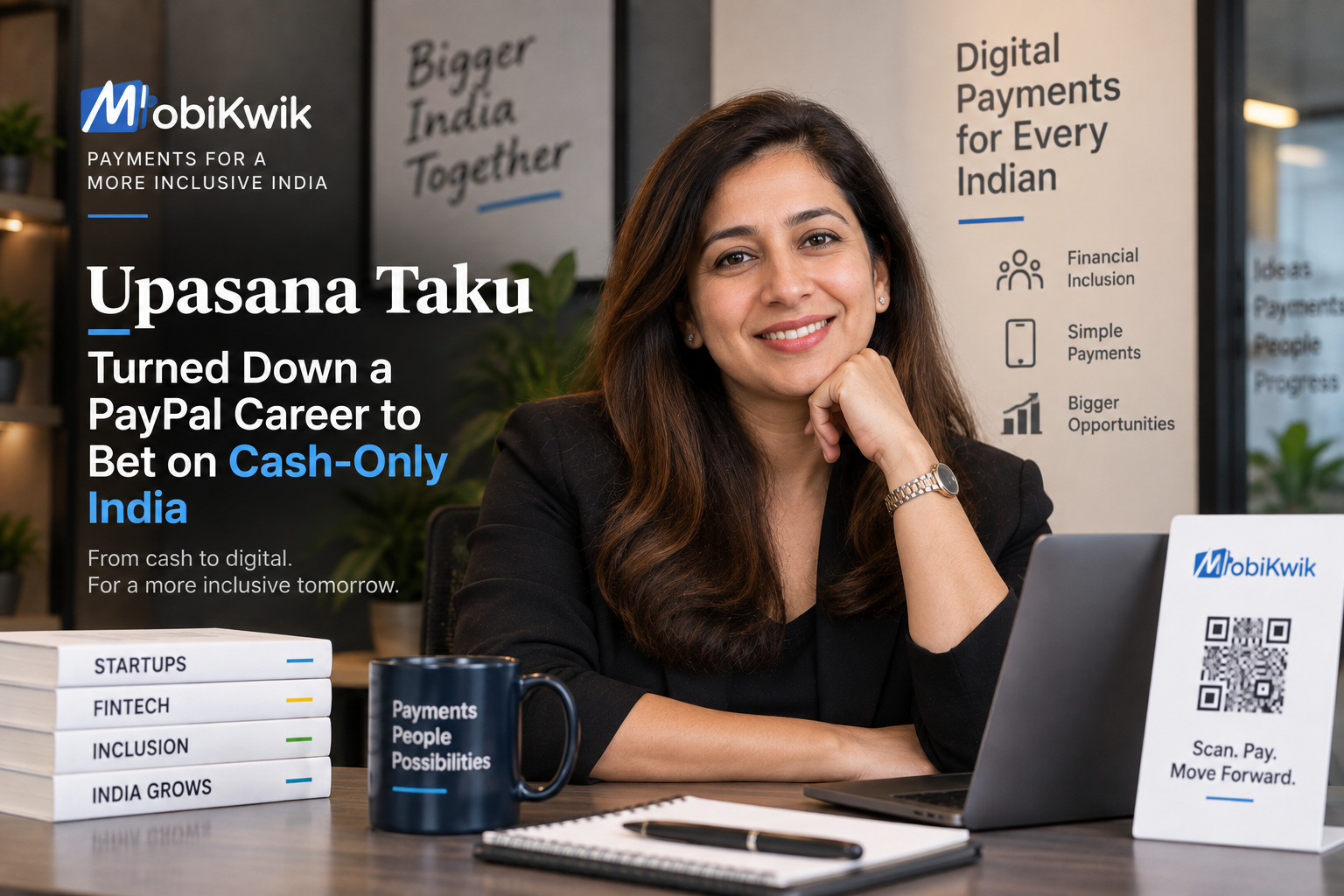
Upasana Taku was working at PayPal in the United States in the late 2000s when she saw something most people in Silicon Valley weren't looking at: India's digital payments infrastructure was close to nonexistent, and cash still dominated nearly every transaction. Rather than continue building her career at one of the world's largest payments companies, she chose to return to India and bet on a market that, on paper, offered none of the infrastructure her PayPal experience assumed was already in place.
Building Trust Before She Had Male-Pattern Investor Comfort
Taku co-founded MobiKwik in 2009 with Bipin Preet Singh — her husband and co-founder — with a vision to build the mobile-first payment rails India didn't yet have. The early fundraising years were genuinely difficult in ways specific to being a woman in a male-dominated fintech field: during investor meetings, she has said she was often asked personal questions rather than substantive ones about the business, a pattern of scrutiny her male co-founder didn't face in the same rooms. She's been candid that coming out of a comfortable, high-paying corporate career to build a payments startup in an underdeveloped market required deliberately stepping outside her comfort zone at every stage.
The Long Middle Stretch
MobiKwik's path from 2009 to eventual profitability wasn't quick. Between 2021 and 2025, the company transformed into a multi-service fintech platform — expanding from digital wallets into UPI, merchant payments, and Buy Now Pay Later products, competing directly against far better-capitalised rivals in Paytm and PhonePe. Taku has said her deliberate strategy through this period was prioritising sustainable growth and user trust over the kind of aggressive cash-burn tactics that defined much of Indian fintech's growth playbook — a slower, more capital-disciplined path that put MobiKwik on a different trajectory than its cash-burning competitors.
The Milestone That Made the Patience Pay Off
That discipline showed up concretely in the numbers. MobiKwik posted its first-ever consolidated quarterly profit — ₹3 crore — in mid-2023, alongside adjusted EBITDA of ₹13.6 crore, up 181 percent year-on-year, making it the first Indian fintech firm to reach consolidated profitability. Taku framed the milestone as bigger than her own company, saying she expected the achievement to boost investor sentiment across the broader Indian startup ecosystem by proving that fintech businesses could actually turn a profit rather than perpetually chase growth.
Getting to the Public Markets, Twice
MobiKwik's IPO journey itself tested that same patience. The company first filed to raise roughly $250 million in 2021, only to shelve the plan when market conditions worsened. It returned with a scaled-down $84 million IPO filing backed by Peak XV, Abu Dhabi Investment Authority and American Express, eventually going public in December 2024 — choosing not to sell any existing shares in the offering, a structure that kept the founders' ownership intact through the listing rather than using the IPO as a partial exit.
Why It Matters for Women Founders
Taku's story is a useful counterpoint to founder narratives built around rapid, headline-grabbing growth. What actually got MobiKwik to India's first fintech profitability wasn't a single breakthrough product or funding round — it was sixteen years of building trust with users and regulators in a market that had almost none of the infrastructure her original PayPal-honed instincts assumed would already exist, while navigating investor rooms that scrutinised her differently than they scrutinised her male co-founder. For women building in capital-intensive, infrastructure-heavy sectors, her trajectory is a reminder that being underestimated in the fundraising process doesn't have to determine the outcome of the business itself.
Women Founders
At www.elevatexstudios.com / ElevateX Studios, Women Founders, part of our Founder Stories series, profiles the women building category-defining Indian businesses — the resistance they navigated and the decisions that got them through it.