Nikhil Kamath Dropped Out at 16 and Spent Years Proving He Didn't Need the Degree
The Zerodha co-founder sold used phones in 10th grade, worked a call centre night shift, and taught himself trading — then built India's largest stockbroker without a single rupee of outside money
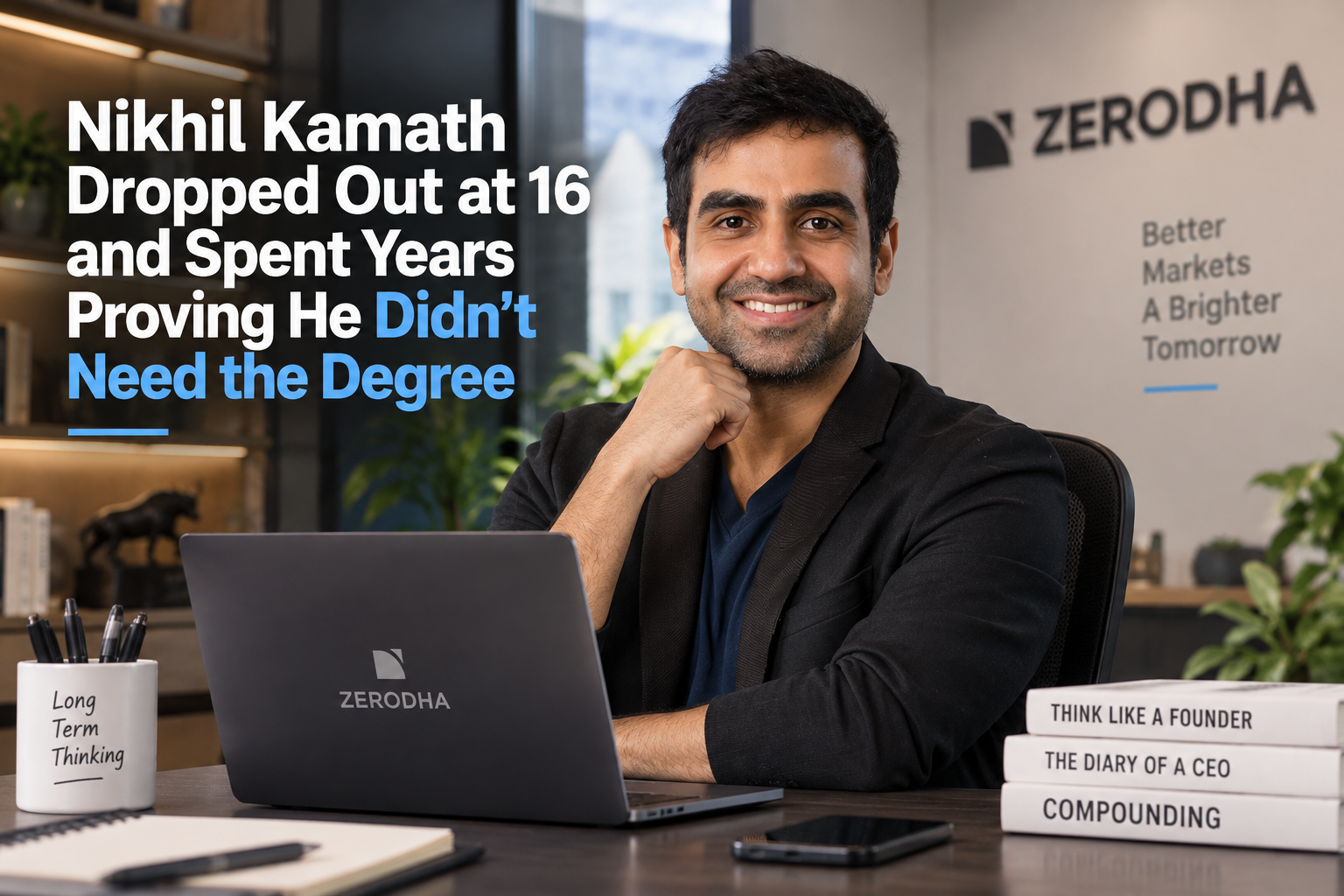
Nikhil Kamath grew up in a middle-class Bangalore household — his father worked at a state-owned bank, his mother taught Carnatic classical music — where dropping out of school was emphatically not the norm. He did it anyway, leaving after Class 10 at around 16. His own explanation has always been blunt rather than romantic: he hated school, and he wasn't inclined toward studying. What he was inclined toward was business. Around 10th grade he had started selling used mobile phones, and that side operation was doing well enough to make the classroom feel beside the point.
The Unglamorous Middle Years
The years immediately after dropping out weren't a straight line to anything. At roughly 17, Kamath joined a call centre — a job he's spoken about openly rather than editing out of his story. During that period he taught himself stock trading, working out market behaviour through his own trial and error rather than through any formal financial education. That self-directed learning eventually became the foundation for his partnership with his older brother Nithin, and in 2010 the two co-founded Zerodha in Bangalore.
Building a Company Around a Conviction
Zerodha's name combines "zero" with "rodha," the Sanskrit word for barrier — a fairly literal statement of what the brothers were trying to remove. At the time, Indian stockbrokers charged high fees and operated on largely opaque pricing. Zerodha launched with a flat, transparent, zero-brokerage-on-delivery model, no external investors, and essentially no advertising spend. It took the company a couple of years to reach its first thousand users. Today it serves over 12 million active clients and holds more than 15 percent of India's retail trading volume, making it the country's largest stockbroker by active client base — built entirely without raising outside capital.
The Drawbacks He Doesn't Pretend Away
What separates Kamath's account from most dropout-success narratives is his refusal to sanitise it. In a conversation with LinkedIn CEO Ryan Roslansky, he acknowledged directly that dropping out of school and skipping formal higher education had real drawbacks — that the absence of a structured educational framework meant working considerably harder to build credibility and knowledge that a degree would have conferred more easily. It's a notably honest framing from someone whose story is frequently used as an argument against formal education entirely.
Beyond Zerodha
Kamath's success journey has since extended well past the brokerage. He co-founded True Beacon, an asset management firm built on a zero-management-fee model, and has backed more than 50 ventures through Gruhas. He launched WTFund to support young founders, and became the youngest Indian signatory of The Giving Pledge, committing half his wealth to philanthropy. As of late 2025, Forbes put his net worth at $3.3 billion.
Why It Matters
Kamath's journey is a useful case study precisely because the credential-free path came with real costs he's willing to name. The lesson isn't that formal education is unnecessary — it's that what actually compounded in his case was a tight feedback loop between effort and outcome, built through selling phones, working a call centre, and losing and making money in the markets himself. The success came from that loop running for years before Zerodha existed, not from the decision to leave school.
Success Journeys
At www.elevatexstudios.com / ElevateX Studios, Success Journeys, part of our Founder Stories series, traces how founders actually got from a first idea to a defining milestone — the setbacks, insights and long stretches of ordinary persistence that don't always make it into the headline.