Kunal Bahl on Rebuilding After Everyone Expected Snapdeal to Die
The Snapdeal and Titan Capital co-founder has spent years unpacking what a near-death experience for his own company taught him about resilience, focus and what actually makes a startup worth backing
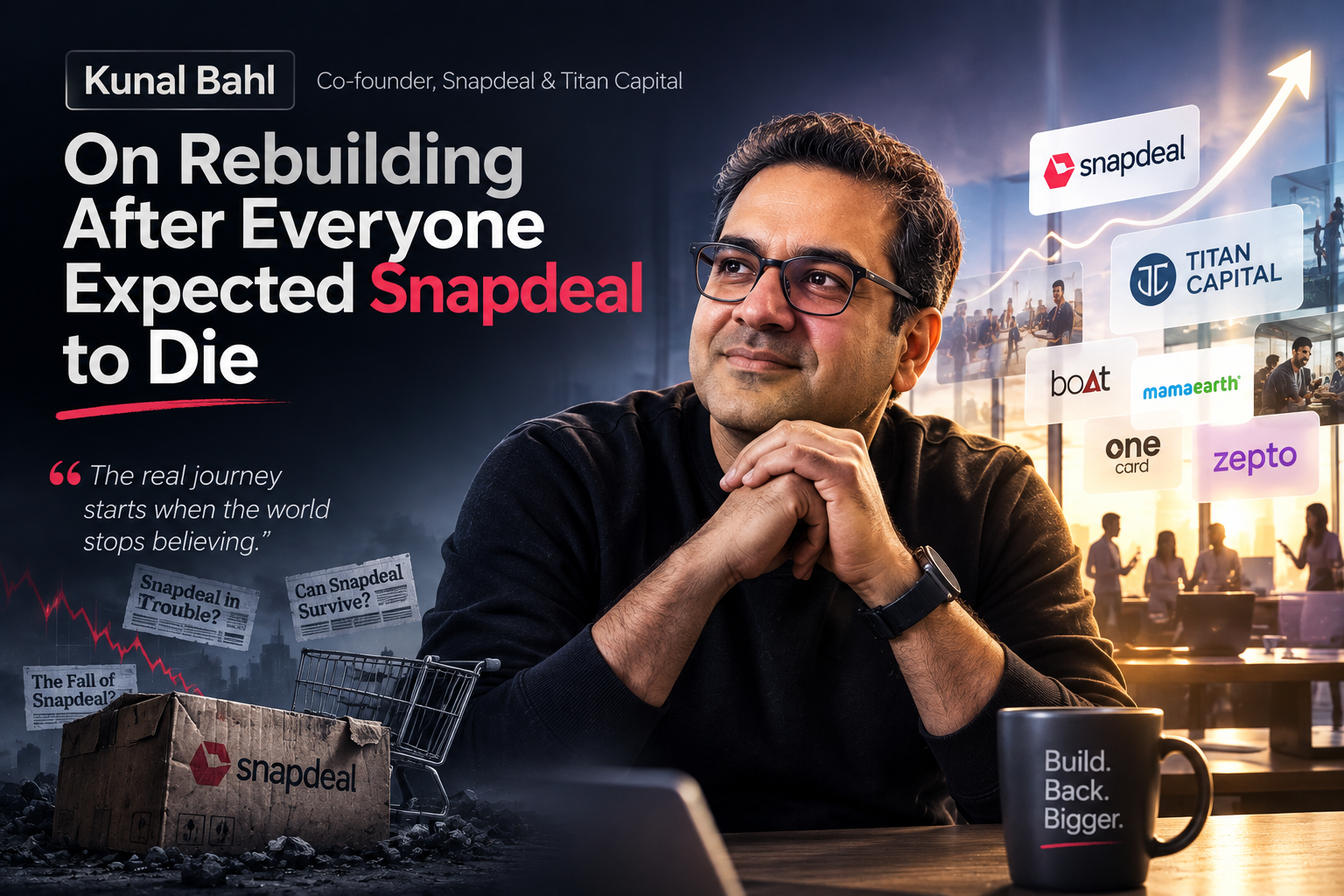
Kunal Bahl co-founded Snapdeal in 2010 with his high school friend Rohit Bansal, initially as a daily deals platform that pivoted into one of India's largest e-commerce marketplaces. Snapdeal's story is well known in Indian startup circles less for its early rise than for what came after: a brutal funding-cycle downturn, a failed merger attempt with Flipkart, and a period where most of the ecosystem had quietly written the company off. What Bahl has spent the years since consistently unpacking, across interviews and his own investing practice, is what that near-collapse actually taught him.
Don't Outsource What You're Supposed to Be Best At
One of Bahl's most repeated pieces of advice to founders is disarmingly simple: identify the one or two things your company absolutely must be the best in the world at — whether that's technology, logistics or understanding your customer — and build that capability in-house rather than outsourcing it. It's advice that reads as a direct lesson from Snapdeal's own turnaround, where regaining control over core capabilities rather than depending on external partners became central to the company's path back to relevance.
Entrepreneurship Doesn't Require a Big Idea, Just a Starting Point
Bahl has also pushed back on a common founder anxiety — waiting for a sufficiently world-changing idea before starting. His own framing, drawn from Snapdeal's post-crisis rebuild under what the company internally called its "2.0" strategy, is that entrepreneurship is fundamentally a state of mind: you don't need a big idea, you need to start solving a real problem, however small it looks at first. The act of starting, in his view, matters more than the size of the initial ambition.
What He Actually Looks for as an Investor
Since 2011, Bahl has formalised his angel investing through Titan Capital, which has now backed more than 250 startups across consumer tech, health tech, fintech and SaaS, including early bets on Ola, Urban Company, Razorpay, Mamaearth and OfBusiness. He's been candid that the team, not the idea, is the factor he weighs most heavily when evaluating an early-stage startup — and that private-market investing takes real mental resilience, best built by investing consistently across both strong and weak cycles rather than opportunistically chasing hot rounds. He has also warned against the instinct many successful entrepreneurs have to invest only occasionally alongside a fund like Titan Capital, arguing that meaningful returns come from sustained, diversified exposure over years, not single high-conviction bets.
Value Creation Happens Between the Headlines
Perhaps his sharpest recent observation is about what actually signals a founder's seriousness. Speaking at TechSparks, Bahl noted that partnerships, product launches and awards are often celebrated as proof of success, but can just as easily reflect a dilution of focus — a chase for the next visible milestone rather than deeper problem-solving. The founders who create real value, in his view, are often the ones working quietly between those headline moments, not the ones generating the most news.
Why It Matters
Bahl's insights carry particular weight because they're not abstract startup wisdom — they're lessons extracted from having personally lived through the version of failure most founders fear most: a company written off by nearly everyone, rebuilt anyway. That vantage point shapes both how he now evaluates the founders he backs and the specific, sometimes unglamorous advice he keeps returning to.
Founder Insights
At www.elevatexstudios.com / ElevateX Studios, Founder Insights, part of our Founder Stories series, looks at the decisions, habits and turning points behind well-known founders' journeys — the moments that reveal how they actually think, not just what they built.