What Kunal Shah's CRED Exit Memo Actually Teaches Founders
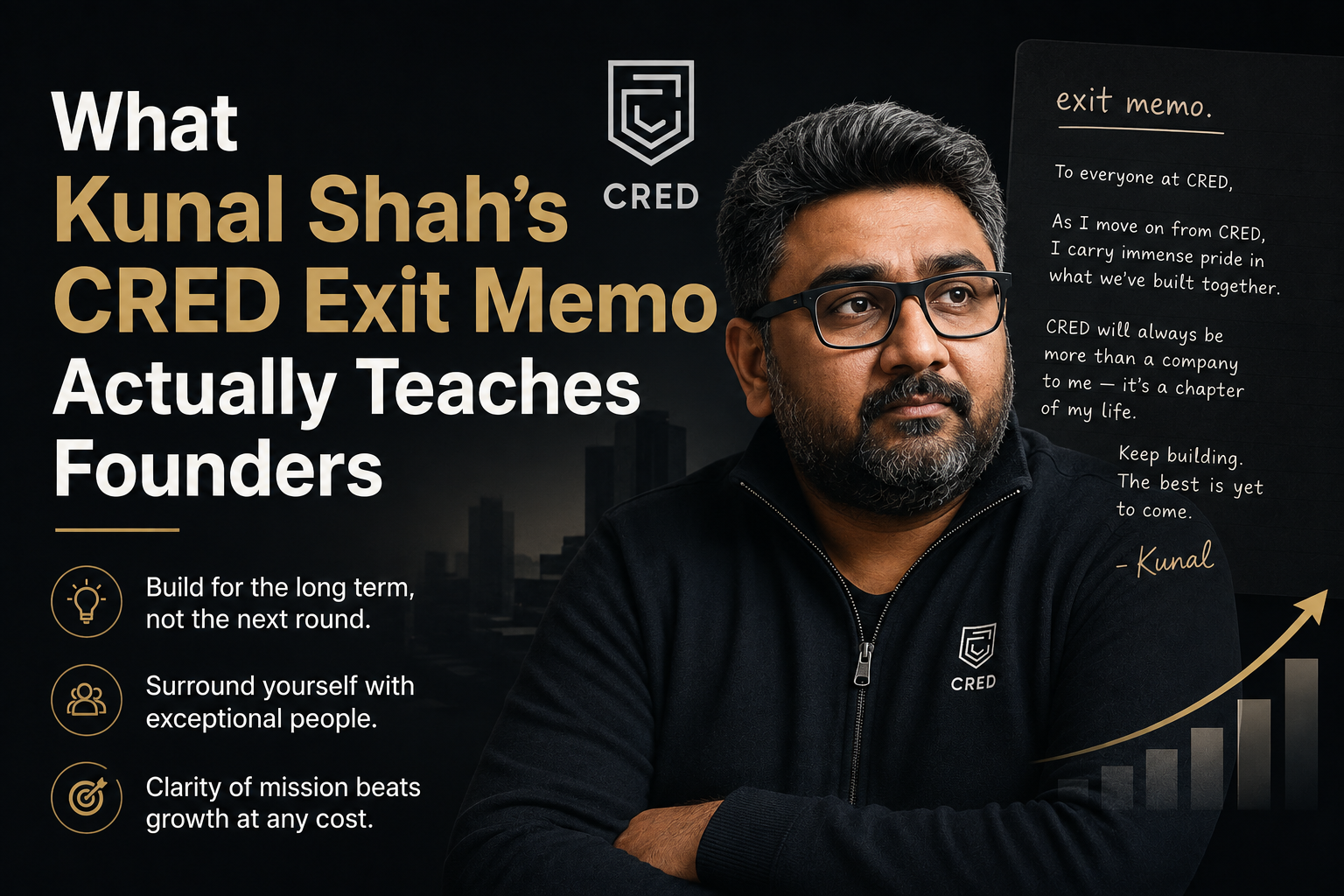
In June 2026, Kunal Shah stepped back as CRED's CEO, handing the role to Miten Sampat — the strategy and finance lead who had worked alongside him since 2020 — while staying on as a shareholder and vice chairman-style presence. He announced it not with a press release but with a long, characteristically candid LinkedIn
The Lesson: Build the Business So It Doesn't Need You
The most useful detail in Shah's memo wasn't the news itself — it was what made the handover possible. He credited Sampat with years of "suffering me," running strategy and finance close enough to the business to take it over without a learning curve. CRED had, by Shah's own account, scaled to roughly $325 million in revenue across payments, lending, insurance, commerce and credit cards, hit its first profitable quarter in 2026, and closed a fresh $900 million round from Meta — all before he stepped back. The lesson: a founder's real exit test isn't whether the company can survive their absence, it's whether someone already inside it is ready to run it better than a new hire could.
The Lesson: Say the Hard Thing About Yourself First
Shah has never been shy about the deeper thesis behind CRED — rewarding financial discipline, betting on "depth" over pure scale, insisting India's low ARPU problem makes revenue harder to build than daily usage. In the same farewell note, he dryly admitted CRED still gets "occasionally asked what our business model is," even after nearly a decade. Naming your own unresolved criticism, in your own exit memo, is a small but telling habit — it signals a founder more interested in being accurate than being flattered.
The Lesson: A Product Has to Be Dramatically Better, Not Slightly Better
Long before the CRED handover, Shah had already built a reputation for blunt frameworks rather than vague inspiration. His "Delta 4" idea holds that a consumer product only stands a real chance of gaining traction if it is at least four points better than the existing alternative on a ten-point scale — a small improvement, in his view, simply isn't worth the effort of switching a habit. It's a useful filter for founders who assume "somewhat better" is enough to win a customer away from what they already use.
The Lesson: Know Where the Money Actually Is
Shah has also been consistent about a harder truth many founders avoid: it is easy to win attention in India, much harder to win revenue. He's pointed out that Indian startups can rack up high daily active users while still struggling to grow average revenue per user, because convincing a price-sensitive market to spend is a fundamentally different problem than getting it to click. His broader point — that a country's profit pools reflect what it actually values, and that copying another market's monetisation playbook rarely translates — is part of why CRED was built around a premium, credit-worthy user base from day one rather than chasing scale for its own sake.
The Lesson: Setbacks Are the Job, Not an Interruption to It
Before CRED, Shah co-founded FreeCharge and sold it to Snapdeal in 2015, then spent years sitting with a single unresolved question — why isn't trust rewarded? — before backing it with $1 million of his own money to start CRED in 2018. He has described entrepreneurship as a field that rewards people who can treat setbacks as part of the puzzle rather than evidence they should quit, and punishes those who take too long to recover from them. CRED's own journey bears that out: the company posted steep losses in its early years before reaching its first profitable quarter in 2026, alongside growth to roughly 17 million members.
Why It Matters
Shah's transition is a useful counter-example to the more common founder-exit story of being pushed out by a board or investors. He picked the moment, picked the successor, and used his own farewell post to keep raising the bar rather than take a victory lap — closing with a line telling the CRED team he'd still expect them to be "a 10x version" of themselves. For founders thinking about their own eventual exit, the takeaway isn't the size of the raise or the valuation — it's whether you've built a team that makes your departure a non-event.
Business Lessons
At www.elevatexstudios.com / ElevateX Studios, Business Lessons, part of our Entrepreneurs coverage, breaks down what founders' real decisions — not just their milestones — actually teach the next generation of business builders.
