A $10 YouTube-Editing Gig Became a $1 Million Agency With 30 Standard Operating Procedures
Mark Santos never wrote a business plan. He wrote one Fiverr gig title, and let five years of systems-building do the rest
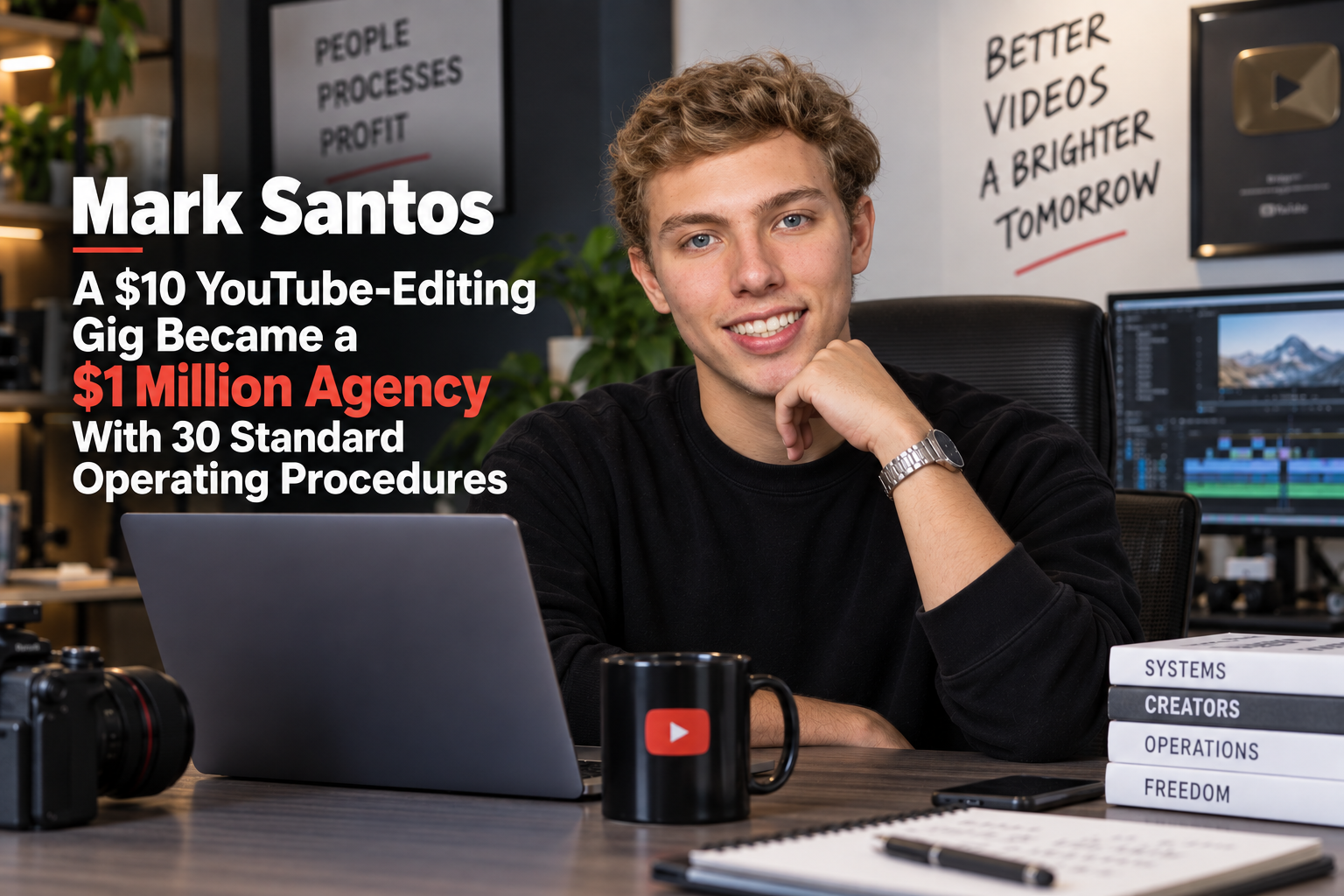
In July 2020, Mark Santos was a university student whose campus had just shut down, whose IT-assistant job was on pause, and whose YouTube ad revenue "wasn't even covering coffee." Scrolling YouTube one night, he came across a creator talking about making money on Fiverr. He already had an account, so he wrote a single gig — "I'll edit your YouTube video for $10" — and hit publish. That, in his own words, was the entire strategy.
The Numbers That Told Him It Was Real
Orders started coming within days. By the end of his first week, he'd edited a gaming montage and a vlog, both on the same dented MacBook running Final Cut Pro. Within eight weeks, he had more than twenty videos in the queue and had earned $2,500 in a single month — matching what his campus IT job paid, except now he was doing work he actually loved. That was the moment the side hustle started looking like something real.
When Growth Started Looking Like Burnout
Success didn't stay simple for long. Within a few months, Santos's Trello board was overloaded — missing assets, version-control chaos, anxious client messages arriving at 2 a.m. Rather than push through it, he paused for an entire weekend and mapped his order-and-editing process end to end, isolating two core problems: tracking client files, and repetitive communication. His fix was to automate and document everything, including coding a Google Apps Script that automatically organised new orders into a master spreadsheet and set up a matching Google Drive folder for each client's briefs and assets. Clients assumed he had an incredible memory. He just had folders and a system.
Building a Team Without Losing Quality
By early 2021, even with better systems, Santos couldn't handle the workload alone. He tested his first hire — a fellow editor who'd helped with his own YouTube videos — on a single project, backed by a lawyer-written contract. It worked well enough to give him his nights back. From there, he built out short Loom videos and checklists for every repeatable task; Mark Studios now runs on more than 30 standard operating procedures, covering everything from color-grading presets to standard "your draft is ready" client messages. He also added a triple-layer quality control system — a QA editor, then a project manager, then Santos himself — completed in under 24 hours per video, which he credits for maintaining a 4.9-star average across more than 6,000 orders.
The Daily Habits Behind the Scale
Santos has been specific about what actually keeps the agency running: clearing Fiverr notifications and the team's WhatsApp chat before breakfast so small issues don't compound, reviewing revision counts, turnaround time, repeat-client rate and customer satisfaction every Friday, and deliberately pricing for quality rather than volume — higher rates, he's said, attract more serious clients and fund better editors and tools. He still handles most client conversations personally, saying relationships matter more to him than automation, even with a fully remote team of editors, virtual assistants and a full-time assistant now serving more than 5,000 clients.
The Warning He Wants Other Freelancers to Hear
Santos has been direct about the biggest misconception freelancers have about scaling: that it makes things easier. In reality, he's said, scaling magnifies every weakness already in your workflow — if your process is shaky at five projects, it collapses at fifty. His advice is sequential, not simultaneous: document every step first, automate the obvious repetitive tasks, and only then delegate to trusted freelancers with clear instructions.
Why It Matters for Freelancers
Santos's account is a useful corrective to the idea that scaling a freelance gig into an agency is mainly about landing bigger clients. What actually got Mark Studios from a $10 gig to a seven-figure business was the unglamorous middle step almost every freelancer skips: pausing growth long enough to document a process before handing any of it to someone else.
Success Stories
At www.elevatexstudios.com / ElevateX Studios, Success Stories, part of our Freelancers coverage, features independent professionals' own accounts of how they actually built sustainable freelance careers — including the systems work most highlight reels leave out.