Mark Suzman Says AI Will Only Be a "Great Equaliser" If India Gets Four Things Right
The Gates Foundation CEO's interview with YourStory, published alongside the 2026 Goalkeepers report, lays out a specific, falsifiable test for whether AI narrows India's inequality gap or widens it
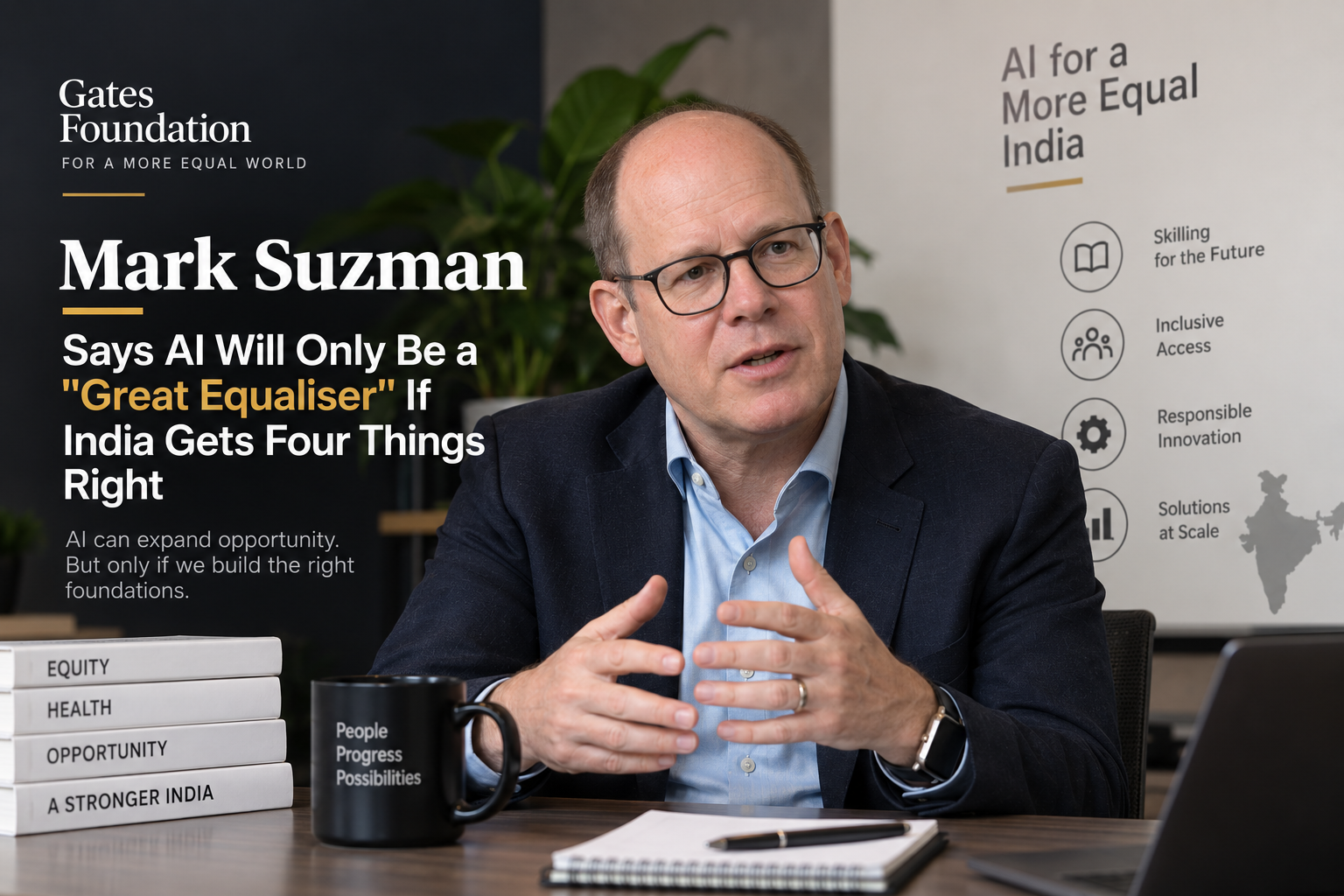
The Gates Foundation released its 2026 Goalkeepers report on September 15, with a blunt central warning: artificial intelligence will either narrow the gap between rich and poor worldwide or widen it, and the choices made over the next two years will decide which. The Foundation backed that warning with a $1 billion, two-year commitment to AI tools built in local languages for health, education and agriculture. Days before the release, Gates Foundation CEO Mark Suzman spoke with YourStory founder and CEO Shradha Sharma about what that warning specifically means for India, fresh off a late-August visit that took in government meetings, innovators and a district hospital in Uttar Pradesh.
The Four-Part Test Suzman Laid Out
Suzman was specific rather than aspirational about what India needs to get right. First, AI needs to be accessible in every local language — usable as spoken language by a healthcare worker, a teacher, or a smallholder farmer, not just available in English text. Second, it needs to be built for local context: an AI tool supporting a farmer must be customised to their state's particular crops, soil, irrigation and government schemes, not deployed as a generic national product. Third, India needs real data protection and governance — both personal data and, distinctly, national and sovereign data. Fourth, it needs sustained investment in people and access: workers trained to use these tools effectively, and genuine access to compute, which Suzman flagged as "a big global battle at the moment." His assessment was that India is making real progress on all four, but that progress needs continued prioritisation from government, the private sector, and philanthropies alike.
The Evidence He Pointed To
Rather than speak in generalities, Suzman cited specific, already-operating examples. Eka Care, a Gates Foundation partner in India, lets community health workers upload pregnancy-tracking data that the system uses to triage at-risk pregnancies and flag nutritional gaps automatically. Separately, Wadhwani AI has built an app that diagnoses potential tuberculosis risk from the sound of a cough recorded on a phone, using an AI algorithm to determine whether a patient needs escalation to more serious TB treatment. Suzman framed both as India-specific proof points of the same pattern the Goalkeepers report highlighted in Rwanda — AI making frontline health workers more effective, not replacing them.
On Jobs, a Direct Answer Rather Than a Dodge
Asked what AI means for the 12 to 14 million young Indians entering the job market every year, Suzman didn't minimise the disruption. He referenced Bill Gates's own recent Gates Notes memo acknowledging that AI is "massively disruptive to certain types of jobs," while arguing the Foundation's own field experience shows AI functioning as a job enhancer in specific roles — making healthcare workers more efficient, letting teachers customise lesson plans, and making farmers more productive members of their local economy. His position was that the risks are real, but that India is comparatively well positioned to address them directly, provided its students are trained to navigate the new AI landscape.
A Sharper Read on Where India Stands Globally
Suzman was candid that India's current growth debate — pushing from 6-7 percent toward 8-9 percent to hit its 2047 middle-income ambition — is a genuinely difficult challenge, but one most of the developing world would trade for in an instant. He contrasted it with much of the rest of Africa and Asia, where countries face steeper fiscal setbacks and a pullback in traditional support from the Global North, making India's specific set of problems look comparatively manageable by global standards.
Why It Matters for CEO Interviews
Suzman's interview is useful precisely because it resists both extremes of the AI conversation — neither uncritical optimism about AI's benefits nor blanket alarm about job losses. His four-part framework gives India (and any country) a concrete, measurable checklist rather than a vague aspiration, and his willingness to name specific Indian partners and products rather than speak abstractly gives the interview a level of testability rare in CEO commentary on AI's societal impact. As the YourStory piece notes, the real test over the next 18 to 24 months is whether India's current head start — in language AI, local-context farm advisories, data governance and compute access — actually converts into a durable lead.
CEO Interviews
At www.elevatexstudios.com / ElevateX Studios, CEO Interviews, part of our Interviews series, brings you conversations with the executives leading India's biggest technology, finance and consumer businesses — what they're building, what's working, and what still worries them.