Amitabh Chaudhry's Third Term Test — Growth Without Cutting Corners on Caution
Seven years after taking over Axis Bank from Shikha Sharma, its CEO is now managing something trickier than a turnaround: defending market share while voluntarily setting aside extra capital nobody made him set aside
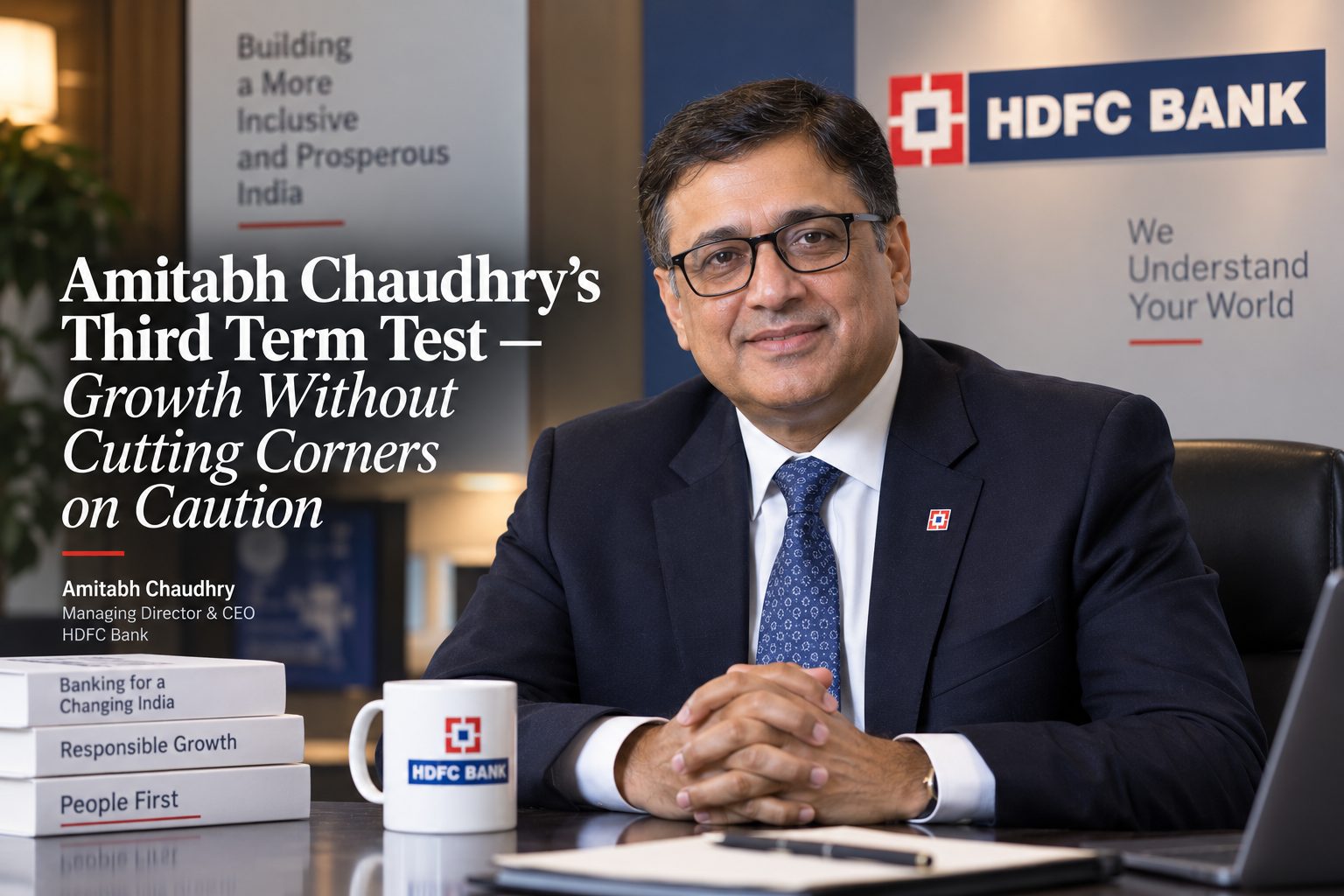
Amitabh Chaudhry took charge of Axis Bank as Managing Director and CEO on January 1, 2019, arriving from a nine-year run at HDFC Life Insurance to replace Shikha Sharma at a bank then grappling with asset quality concerns and lingering NBFC-sector stress. The Reserve Bank of India has since renewed his mandate twice — most recently extending his term through December 31, 2027 — making this his third consecutive term running one of India's largest private-sector lenders.
What He Actually Changed
Chaudhry's early tenure was built around a specific, measurable pivot: growing Axis Bank's share of retail assets, tightening underwriting standards, and improving the overall quality of the bank's earnings rather than chasing loan book growth for its own sake. Analysts reviewing his first year noted more hits than misses — a stock up double digits, an improving loan mix — even as full asset-quality repair took longer than hoped. The defining strategic move of his tenure came in 2023, when Axis Bank completed its acquisition of Citibank's Indian retail banking and NBFC consumer businesses, a deal that materially reshaped the bank's retail franchise and remains a recurring reference point in the bank's own quarterly disclosures years later.
A Bank That Keeps Choosing Caution Over a Cleaner Headline Number
What distinguishes Chaudhry's recent public communication is his consistent willingness to take a short-term profit hit in the name of balance-sheet resilience. In Q4 FY26, Axis Bank voluntarily created an additional one-time provision of ₹2,001 crore, on top of its regular provisioning, specifically to strengthen the bank against what it called evolving and unpredictable macroeconomic and geopolitical uncertainty — even while stating plainly that the move did not reflect any actual deterioration in loan quality. It's a notable disclosure practice: flagging a defensive capital move explicitly as precautionary rather than letting the market assume the worst from the number alone.
That same instinct showed up across FY26's results. Net interest income grew a modest 3 percent to ₹56,048 crore, and operating profit rose just 2 percent to ₹42,817 crore, numbers that reflect a bank prioritising discipline over aggressive expansion in what Chaudhry described, on the Q4 earnings call, as a financial year that unfolded against a complex and uncertain global backdrop — tariff issues, and more recently the West Asia conflict, disrupting global supply chains and adding volatility to markets even as the Indian economy showed relative resilience.
Betting the Next Phase on AI, Not Just Balance Sheet Repair
Chaudhry has increasingly framed Axis Bank's next chapter around technology rather than pure credit discipline. He's spoken of a roadmap for AI-driven scale-up expected to drive meaningful bottom-line impact, alongside continued investment in digital security and simplifying customer journeys — priorities he's tied directly to what he calls building a franchise that combines trust, innovation and resilience at scale. The bank's domestic subsidiaries — Axis Finance, Axis AMC, Axis Securities, Axis Capital — have also been performing solidly, with Axis Finance's FY26 profit up 19 percent year-on-year, giving Chaudhry a diversified base to point to beyond the core lending business.
Why It Matters for Market Leaders
Chaudhry's third term is a useful study in how a market-leading bank manages the tension between growth expectations and prudence once a turnaround is largely complete. Rather than treating a stable asset-quality picture as license to loosen provisioning, he's continued voluntarily over-provisioning against uncertainty — a stance that trades some short-term profit optics for balance-sheet credibility, a trade a CEO only three years from the end of his mandate can make with real conviction if he's confident the market will eventually reward the discipline rather than punish the slower headline growth.
CEO Profiles
At www.elevatexstudios.com / ElevateX Studios, CEO Profiles, part of our Market Leaders coverage, looks at the executives currently running India's dominant companies — how they got the job, what they inherited, and what they're being judged on next.